Ancient Greece Art Architecture and History Cycladic Art Getty Pdf
Introduction to Ancient Hellenic republic
Ancient Greek culture spans over a grand years, from the earliest civilizations to the cultures that became the Ancient Greeks.
Learning Objectives
Illustrate a timeline of ancient Hellenic republic from the Statuary Age to the Hellenistic menstruation
Primal Takeaways
Key Points
- Ancient Greek culture is noted for its government, art, architecture, philosophy, and sports, all of which became foundations for mod western society. It was admired and adopted past others, including Alexander the Cracking and the Romans, who helped spread Greek civilization around the world. Before Greek culture took root in Hellenic republic, early civilizations thrived on the Greek mainland and the Aegean Islands. The autumn of these cultures and the aftermath, known as the Dark Age, is believed to exist the time when the Homeric epics were outset recited.
- Greek civilization began to develop during the Geometric, Orientalizing, and Primitive periods, which lasted from 900 to 480 BCE. During this time the population of city-states began to grow, Panhellenic traditions were established, and art and compages began to reflect Greek values .
- The Early on, High, and Late Classical periods in Greece occurred from 480 to 323 BCE. During these periods, Greece flourished and the polis of Athens saw its Golden Age under the leadership of Pericles. However, city-state rivalries led to wars, and Greece was never truly stable until conquered.
- The Hellenistic period in Greece is the last period earlier Greek culture becomes a subset of Roman hegemony. This menstruum occurs from the death of Alexander the Groovy in 323 BCE, to the Greek defeat at the Battle of Actium in thirty BCE. It marks the spread of Greek civilization across the Mediterranean.
Primal Terms
- polis: A city, or a city-land. Its plural is poleis.
Ancient Greek Civilization
Ancient Greek culture covers over a thousand years of history, from the primeval civilizations in the area to the cultures that became the Aboriginal Greeks. Post-obit a Greek Dark Historic period, Hellenic republic over again flourished and adult into the ancient culture that we recognize today .
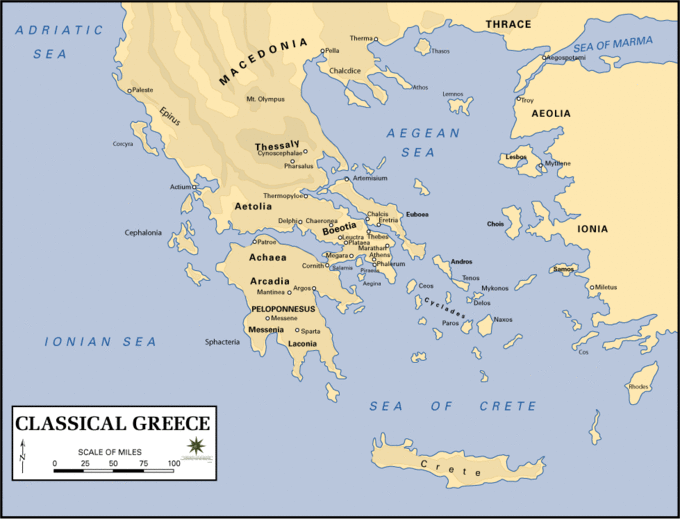
Classical Greece: Map of Aboriginal Greece.
Greek culture is based on a series of shared values that continued contained urban center-states throughout the region, and expanded as far north as Mount Olympus. Greek society was insular, and loyalties were focused around one'due south polis (metropolis-country). Greeks considered themselves civilized and considered outsiders to exist barbaric.
While Greek daily life and loyalty was centered on 1'due south polis, the Greeks did create leagues, which vied for control of the peninsula, and were able to unite together against a common threat (such every bit the Persians).
Greek culture is focused on their regime, art, architecture, philosophy, and sport. Athens was intensely proud of its cosmos of democracy, and citizens from all poleis (urban center-states) took function in civic duties. Cities commissioned artists and architects to award their gods and beautify their cities.
Greek philosophers, mathematicians, and thinkers are still honored in society today. As a religious people, the Greeks worshipped a number of gods through sacrifices, rituals, and festivals.
Bronze Age and Proto-Greek Civilizations
Cycladic Civilization
During the Bronze Age, several distinct cultures developed effectually the Aegean. The Cycladic civilization, effectually the Cyclades Islands, thrived from 3,000 to 2,000 BCE. Picayune is known most the Cycladic culture because they left no written records. Their fabric culture is mainly excavated from grave sites, which reveal that the people produced unique, geometric marble figures.
Minoan Culture
The Minoan civilisation stretches from 3700 BCE until 1200 BCE, and thrived during their Neopalatial period (from 1700 to 1400 BCE), with the large-scale edifice of communal palaces. Numerous archives accept been discovered at Minoan sites; however their linguistic communication, Linear A , has yet to be deciphered. The culture was centered on trade and production, and the Minoans were keen seafarers on the Mediterranean Sea.
Mycenaean Civilization
A proto-Greek culture known as the Mycenaeans developed and flourished on the mainland, eventually acquisition the Aegean Islands and Crete, where the Minoan civilisation was centered. The Mycenaeans adult a fractious, war-similar culture that was centered on the say-so of a single ruler. Their culture eventually complanate, but many of their citadel sites were occupied through the Greek Nighttime Age and rebuilt into Greek city-states.
The Dark Age
From around 1200 BCE, the palace centers and outlying settlements of the Mycenaeans' civilization began to be abased or destroyed. By 1050 BCE, the recognizable features of Mycenaean civilisation had disappeared.
Many explanations attribute the fall of the Mycenaean culture and the collapse of the Bronze Historic period to climatic or environmental ending, combined with an invasion by the Dorians or by the Sea Peoples, or to the widespread availability of edged weapons of iron, simply no single explanation fits the available archaeological prove.
This ii- to 3-century span of history is also known as the Homeric Age. Information technology is believed that the Homeric epics The Iliad and The Odyssey were first recited around this time.
The Geometric and Orientalizing Periods
The Geometric catamenia (c. 900–700 BCE), which derives its proper noun from the proliferation of geometric designs and rendering of figures in art, witnessed the emergence of a new culture on the Greek mainland. The civilization'due south change in language, its adaptation of the Phoenician alphabet, and its new funerary practices and material culture suggest the ethnic population changed from the mainland's previous inhabitants, the Mycenaeans.
During this fourth dimension, the new culture was centered on the people and independent poleis, which divided the land into regional populations. This flow witnessed a growth in population and the revival of trade.
The Orientalizing period (c. 700–600 BCE) is named for the cultural exchanges the Greeks had with Eastern, or Oriental civilizations. During this fourth dimension, international trade began to flourish. Art from this period reflects contact with locations such as Egypt, Syria, Assyria, Phoenicia, and State of israel.
Archaic Greece
Greece's Archaic catamenia lasted from 600 to 480 BCE, in which the Greek civilization expanded. The population in Greece began to rise and the Greeks began to colonize along the coasts of the Mediterranean and the Blackness Ocean. The poleis at this time were typically ruled past a single ruler who commanded the urban center by force.
For the metropolis of Athens, this led to the cosmos of democracy. Several city-states emerged as major powers, including Athens, Sparta, Corinth, and Thebes. These poleis were oftentimes warring with each other, and formed coalitions to proceeds power and allies. The Western farsi invasion of Greece in 480 BCE marked the end of the Archaic period.
Classical Hellenic republic
The era of Classical Greece began in 480 BCE with the sacking of Athens by the Persians. The Western farsi invasion of Greece, first led by Darius I and then past his son Xerxes, united Hellenic republic against a common enemy.
With the defeat of the Persian threat, Athens became the most powerful polis until the beginning of the Peloponnesian War in 431 BCE. These wars continued on and off until 400 BCE. While marred past war, the Classical period saw the height of Greek culture and the creation of some of Hellenic republic'due south most famous fine art and architecture.
Nevertheless, peace and stability in Greece was non achieved until information technology was conquered and united by Republic of macedonia under the leadership of Philip II and Alexander the Great in the mid-third century BCE.
Hellenistic Greece
The Hellenistic menstruation began with the death of Alexander the Slap-up in 323 BCE, and concluded with the Roman victory at the Boxing of Actium in 30 BCE. Greece poleis spent this fourth dimension nether the hegemony of strange rulers, beginning the Macedons and and so the Romans, starting in 146 BCE.
New centers of Hellenic culture flourished through Greece and on strange soil, including the cities of Pergamon, Antioch, and Alexandria—the capitals of the Attalids, Seleucids, and Ptolemies.
The Ancient Greek Gods and Their Temples
Greek religion played a central and daily role in the life of ancient Greeks, and group worship was centered on the temple and cult sites.
Learning Objectives
Describe the ways in which Greek life and art was influenced by the gods
Key Takeaways
Key Points
- The history of the Greek pantheon begins with the primordial deities Gaia and Uranus and their children, the Titans. The pantheon of Greek gods consisted of twelve Olympian gods plus a variety of additional principal and minor gods and goddesses. The gods had homo characteristics and personalities, and their lives were detailed by the mythologies told about them.
- The gods played a central office in Greek daily life. They were consulted, blamed, and honored for a variety of reasons, including natural occurrences (from earthquakes to pelting), too every bit for the public and individual affairs of the polis and its people.
- The mythologies and cult worship of heroes also played an important role in Greek faith and ritual. Heroes—especially Perseus, Hercules, Theseus, and those involved in the Trojan State of war—were oftentimes depicted in art, and the location of their feats became cult sites.
- The temple was considered the abode of the god and was often an expensive and lavishly busy building. The temple included a naos, the main room that held the cult statue. Offerings and dedications were left for the gods, and sacrifices took place outdoors.
Key Terms
- primordial: Existing at or earlier the beginning of time.
- demigod: A half-god or hero; the offspring of a deity and a mortal.
- libation: The deed of pouring a liquid or liquor, unremarkably vino, either on the ground or on a victim in sacrifice, in honor of some deity.
- naos: The central room in the god's temple, where a cult statue of the god is erected.
- polytheistic: A religious system whose members worship many deities.
- votive: A small religious offering deposited at a temple without the purpose of display or retrieval.
Greek religious traditions encompassed a big pantheon of gods, complex mythologies, rituals, and cult practices. Greece was a polytheistic club, and looked to its gods and mythology to explain natural mysteries likewise as current events. Religious festivals and ceremonies were held throughout the year, and animal sacrifice and votive offerings were pop ways to appease and worship the gods. Religious life, rituals, and practices were ane of the unifying aspects of Hellenic republic across regions and poleis (cities, or city-states, such equally Athens and Sparta).

The principal religious sanctuaries of the Greek Aegean: This map lists the major Greek gods and shows where their main religious sanctuaries are located throughout the Greek Aegean region.
Greek Gods
Greek gods were immortal beings who possessed human-like qualities and were represented as completely human in visual art. They were moral and immoral, petty and just, and frequently vain. The gods were invoked to intervene and assist in matters large, small, private and public.
City-states claimed individual gods and goddess as their patrons. Temples and sanctuaries to the gods were built in every metropolis. Many cities became cult sites due to their connection with a god or goddess and specific myths. For instance, the metropolis of Delphi was known for its oracle and sanctuary of Apollo, because Apollo was believed to accept killed a dragon that inhabited Delphi.
The history of the Greek pantheon begins with the primordial deities Gaia (Female parent Earth) and Uranus (Male parent Sky), who were the parents of the first of twelve giants known equally Titans. Amidst these Titans were six males and six females.
- The males were named Oceanus, Hyperion, Coeus, Crius, Iapetus, and Kronos.
- The females were named Themis, Mnemosyne, Tethys, Theia, Phoebe, and Rhea.
Kronos somewhen overthrew Uranus and ruled during a mythological Gilded Historic period. Over time, he and Rhea had twelve children who would become the Olympian gods. However, Kronos heard a prophecy that his son would overthrow him, as he did to Uranus. In an effort to avert fate, he ordered Rhea to allow him to devour each of the children upon their birth.

Themis: One of the first 12 Titans, Themis was the personification of divine law, as opposed to human ordinance.
The Olympian Gods
All-time known amongst the pantheon are the twelve Olympian gods and goddesses who resided on Mt. Olympus in northern Hellenic republic. Zeus, the youngest son of Rhea and Kronos, was hidden from his male parent, instead of being swallowed. In one case he became a human being, he challenged his begetter's rule, forcing Kronos to regurgitate the rest of his swallowed children. These children were Zeus's siblings, and together they overthrew Kronos, making Zeus the male parent of gods and men.
Violence and power struggles were common in Greek mythology, and the Greeks used their mythologies to explain their lives around them, from the change in seasons to why the Persians were able to sack Athens.
The traditional pantheon of Greek gods includes
- Zeus, the king of gods and the ruler of the heaven,
- Zeus' two brothers, Poseidon (who ruled over the sea) and Hades (who ruled the underworld).
- Zeus's sister and wife, Hera, the goddess of matrimony, who is frequently jealous and vindictive of Zeus'southward other lovers.
- Their sisters Hestia, the goddess of the hearth, and Demeter, the goddess of grain and civilisation.
- Zeus's children:
- Athena (goddess of warfare and wisdom).
- Hermes (a messenger god and god of commerce).
- the twins Apollo (god of the sun, music, and prophecy) and Artemis (goddess of the hunt and of wild animals).
- Dionysos (god of wine and theatre).
- Aphrodite (goddess of dazzler and love), who was married to Hephaestus (deformed god of the forge).
- Ares (god of state of war and lover of Aphrodite) are also office of the traditional pantheon.
- Hephaestus was in some mythologies the son of Zeus while in others the fatherless son of Hera.

Hermes and the Infant Dionysos by Praxiteles: Here, Hermes cares for the now motherless Dionysos. Originally, Hermes held a bunch of grapes, with which he teased the baby god of wine. c. quaternary century BCE.
Heroes
Heroes, who were often demigods, were as well important characters in Greek mythology. The 2 most important heroes are Perseus and Hercules.
Perseus
Perseus is known for defeating the Gorgon, Medusa. He slew her with assist from the gods: Athena gave him armor and a reflective shield, and Hermes provided Perseus with winged sandals so he could fly.
Hercules
Hercules was a strong only unkind man, a drunk who conducted huge misdeeds and social faux pas. Hercules was sent on twelve labors to atone for his sins as penalty for his misdeeds. These deeds, and several other stories, were often depicted in art, on ceramic pots, or on temple metopes. The most famous of his deeds include slaying both the Nemean Lion and the Hydra, capturing Cerberus (the dog of the underworld), and obtaining the apples of the Hesperides.
Theseus
A tertiary hero, Theseus, was an Athenian hero known for slaying King Minos'southward Minotaur. Other major heros in Greek mythology include the warriors and participants of the Trojan State of war, such as Achilles, Ajax, Odysseus, Agamemnon, Paris, Hector, and Helen.
Hero cults were another pop form of Greek worship that involved the honoring of the dead, specifically the dead heroes of the Trojan State of war. The sites of hero worship were commonly onetime Bronze Age sites or tombs that the ancient Greeks recognized as important or sacred, which they and so connected to their own legends and stories.

Hercules and Cerberus: Hercules bringing Cerberus dorsum to Rex Eurystheus. Black effigy hydra. c. 525 BCE.
Sacred Spaces
Greek worship was centered on the temple. The temple was considered the habitation of the god, and a cult statue of the god would exist erected in the key room, or the naos. Temples generally followed the same basic rectangular programme, although a round temple, known as a tholos, were used at some sites in starting in the Classical period.
Temples were oriented due east to face the rising sun. Patrons would get out offerings for the gods, such as pocket-size votives, large statues, libations or costly goods. Due to the wealth dedicated to the gods, the temples often became treasuries that held and preserved the wealth of the city. Greek temples would be extensively decorated, and their construction was a long and costly endeavour.
Rituals and animal sacrifices in accolade of the god or goddess would take place outside, in front of the temple. Rituals often included a large number of people, and sacrifice was a messy business that was best done outdoors. The development and decoration of temples is a primary focus in the study of Greek fine art and culture.

Sacrificial scene: Scene of a sacrifice. Attic cherry-red-figure bell krater. Circa 430–420 BCE. Athens, Greece.
halliganirint1985.blogspot.com
Source: https://courses.lumenlearning.com/boundless-arthistory/chapter/introduction-to-ancient-greece/
0 Response to "Ancient Greece Art Architecture and History Cycladic Art Getty Pdf"
Post a Comment