Recently Stayed With Family Then Got Bed Bugs
How to Find Bed Bugs
Información relacionada disponible en español
If you have a bed bug infestation, it is best to find it early on, before the infestation becomes established or spreads. Treating a pocket-size infestation, while an inconvenience, is far less costly and easier than treating the aforementioned infestation subsequently it becomes more widespread.
Nonetheless, low-level infestations are also much more than challenging to detect and correctly identify. Other insects, such equally carpeting beetles, can be easily mistaken for bed bugs. If you misidentify a bed bug infestation, it gives the bugs more than time to spread to other areas of the house or hitchhike a ride to someone else'south house to beginning a new infestation. Larn about identifying bed bugs.
Bites on the skin are a poor indicator of a bed bug infestation. Bed bug bites can await similar bites from other insects (such as mosquitoes or chiggers), rashes (such equally eczema or fungal infections), or even hives. Some people exercise not react to bed bug bites at all.
On this folio:
- Looking for signs of bed bugs
- Where bed bugs hide
- Bed bug behavior and habits
Looking for Signs of Bed Bugs

A more authentic fashion to identify a possible infestation is to expect for physical signs of bed bugs. When cleaning, irresolute bedding, or staying abroad from home, look for:
- Rusty or red stains on bed sheets or mattresses caused past bed bugs being crushed.
- Night spots (about this size: •), which are bed bug excrement and may bleed on the cloth similar a marker would.
- Eggs and eggshells, which are tiny (about 1mm) and pale yellowskins that nymphs shed equally they grow larger.
- Live bed bugs.
Where Bed Bugs Hide
When not feeding, bed bugs hibernate in a variety of places. Around the bed, they can be found nearly the piping, seams and tags of the mattress and box jump, and in cracks on the bed frame and headboard.
If the room is heavily infested, you may find bed bugs:
- In the seams of chairs and couches, betwixt cushions, in the folds of curtains.
- In drawer joints.
- In electric receptacles and appliances.
- Under loose wall paper and wall hangings.
- At the junction where the wall and the ceiling meet.
- Fifty-fifty in the head of a screw.
Since bed bugs are just almost the width of a credit carte du jour, they can squeeze into really minor hiding spots. If a crack volition concord a credit card, it could hibernate a bed bug.
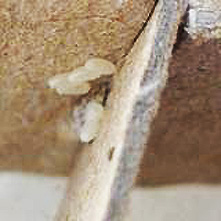
Close upwardly of bed bug eggs on cardboard
Photo courtesy: Harold Harlan
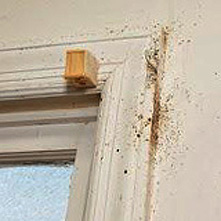
Bed bugs along the side of a window frame
Photograph courtesy: Jung Kim
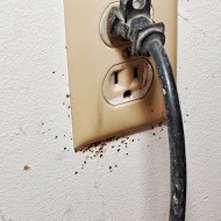
Bed bugs forth the bottom border of an electrical outlet
Bed Bug Behavior and Habit
Understanding the behavior of bed bugs (how they eat, live, and reproduce) will help you to discover an infestation before information technology becomes established and to monitor for the presence of bed bugs after your dwelling has been treated.
Feeding:
- Appear to adopt to feed on humans, but will feed on other mammals and birds as well.
- Will readily travel 5-20 feet from established hiding places (called harborage) to feed on a host.
- Even though they are primarily active at night, if hungry they volition seek hosts in full daylight.
- Feeding can take 3-12 minutes.
- The rusty or tarry spots found on bed sheets or in problems hiding places are considering 20% of the time adults and big nymphs will void remains of earlier claret meals while nevertheless feeding.
Life stages/mating:
- Bed bugs need at least i claret repast before the private problems can develop to the next of the half-dozen life stages.
- They can feed more once.
- Each stage too requires the molting of skin.
- To continue to mate and produce eggs, both males and females must feed at least one time every 14 days.
- Each female may lay 1 to three eggs per twenty-four hours and 200-500 eggs per her lifetime (6-12 months but could exist longer).
- Egg-to-egg life cycle may take four to five weeks under favorable conditions.
Living conditions:
- Bed bugs can survive and remain active at temperatures as depression every bit 7°C (46°F), but they die when their body temperatures reaches 45°C (113°F).
- To impale bed bugs with oestrus, the room must be even hotter to ensure sustained heat reaches the bugs no thing where they are hiding.
- Mutual bed bugs are found almost anywhere their host can alive.
- Tropical bed bugs (Cimex hemipterus) require a higher average temperature than the common bed bug and are establish in tropical and subtropical areas.
halliganirint1985.blogspot.com
Source: https://www.epa.gov/bedbugs/how-find-bed-bugs
0 Response to "Recently Stayed With Family Then Got Bed Bugs"
Post a Comment