Warman's Depression Glass: Identification and Value Guide Read Online
Afterwards inheriting her grandmother's collection of antiques, Dolores has maintained an interest in the intendance and sale of vintage items.
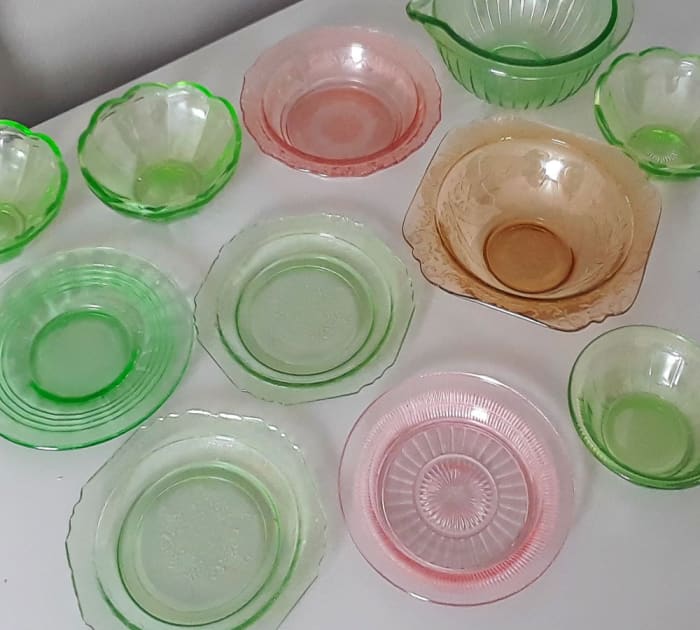
Depression glass in a variety of patterns and colors
Photo by Dolores Monet
What Is Depression Glass?
Depression drinking glass refers to a particular type of glass that is often associated with the Neat Depression. However, many of the drinking glass companies that offered the pretty patterned drinking glass had been in business long before the stock market crash of 1929. Federal Glass Company, for example, opened in 1900. When information technology and other companies automated product techniques and began to offer inexpensive glass dinner and luncheon ware, consumers on the lower end of the economic spectrum were able to afford the pretty drinking glass.
During the 1930s, the general public was unable to beget the niceties of life. People who were able to hang onto jobs ofttimes had their hours cut, and the rest lived in fear of job loss. Many lost their life savings when banks complanate. Many businesses failed as a consequence of the harsh economic weather.
Some businesses that remained open offered incentives for consumers in order to remain afloat. Depression glass was frequently used equally an enticement to concenter customers. Picture theaters featured "glass night" when attendees received free glassware along with the bear witness. Low drinking glass was offered along with the purchase of kitchen appliances. Some pieces were included in boxes of soap or oatmeal.
Depression-era homemakers could find their favorite patterns at the 5-and-ten or Woolworth's for as little equally five cents each.
Glassware Facts
- Not all Depression glass is colored. Though articulate pink and green have long been popular colors, other colors included amber, blueish, amethyst, ruby red, and black. Many companies offered clear uncolored patterns usually referred to as "crystal" though they were not crystal per se.
- Non all colored glass is Depression glass. If the drinking glass was handmade or hand-finished, it is generally not Low drinking glass.
- Elegant glass is sometimes included in the genre though many purists disagree. When the United States emerged from the Great Low, new paw-finished glassware was sold at better department stores, though information technology had been produced for some time. Elegant glass usually shows an etched, highly polished pattern while Depression glass features slightly raised designs.
- Carnival glass is iridescent hand-finished glass produced from 1900–1925. Most pieces are decorative rather than functional. However, the Normandie pattern offered by the Federal Glass Visitor from 1933–1940 did accept an iridescent quality.
- Just considering it shows up on a Google epitome search does not mean it is Depression glass. This handy tool is a great place to browse pictures but images of other things may appear. Use the search to locate reliable pages.
- Non all Low glass is translucent. Some items appeared in an opaque red, blackness, or green. Opaque white is thinner than milk drinking glass.
The Collecting Craze
As the babe boomers plunged into a collecting mania in the 1980s, reproductions of popular vintage items were rampant. Some reproductions were created to fool buyers as the value of Depression glass skyrocketed. Other copies were offered just because people liked the wait and did not want to apply the real affair.
During those years, people bought up things for investment. The concept that "they don't make this whatever more" convinced buyers that the value could merely escalate. Some shoppers had the idea that prices could only go upward. Of course the value of collectables does become upwardly as long equally there is a need.
As baby boomers began to downsize, suddenly anybody wanted to sell their one-time stuff. More and more Depression glass appeared on the marketplace. But decorating trends influence shopping habits. The movement toward minimalism steered young people away from the fussy glass toward simpler items.
The good news is that the marketplace is swell for buyers. Prices go down with less demand. But buyers should yet beware of the fakes of the late-20th century. Many avid collectors say they tin place the real thing past how it feels. For the near part, real Depression drinking glass is lighter than reproductions. There may exist slight imperfections in authentic Depression glass like tiny bubbles or ripples. Some may testify small scratches from use.
If you want to collect a item pattern, go to know that design. Look closely at it. Concur it up to the calorie-free to written report the colour (the color of a fake may exist off). Feel the heft of it. You should before long be able to judge what is real versus what is fake.
How to Identify a Pattern
Use a volume or online guide to identify your design. Many guides provide unproblematic images to make this easy. Await for several different things.
Silhouette
Shape guides display the general outline of a plate or bowl. Notice dips, scallops, or beaded edges. A plate may feature a smooth border interrupted by dips. Trace the outline as shown below on a slice of paper. This makes comparison easier without the distraction of color or pattern details.
Notice where arcs, swirls, or other details lay on the edge of the item. Count big, obvious details such every bit the 6 straight edges on the green Florentine #1 sherbet plate as illustrated below.
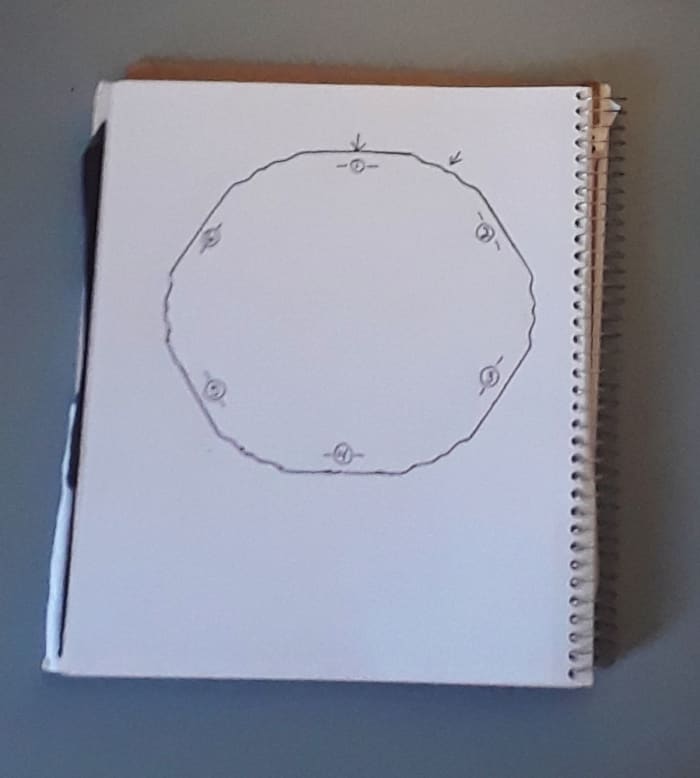
Trace a plate onto a slice of paper to see the outline
Photograph past Dolores Monet
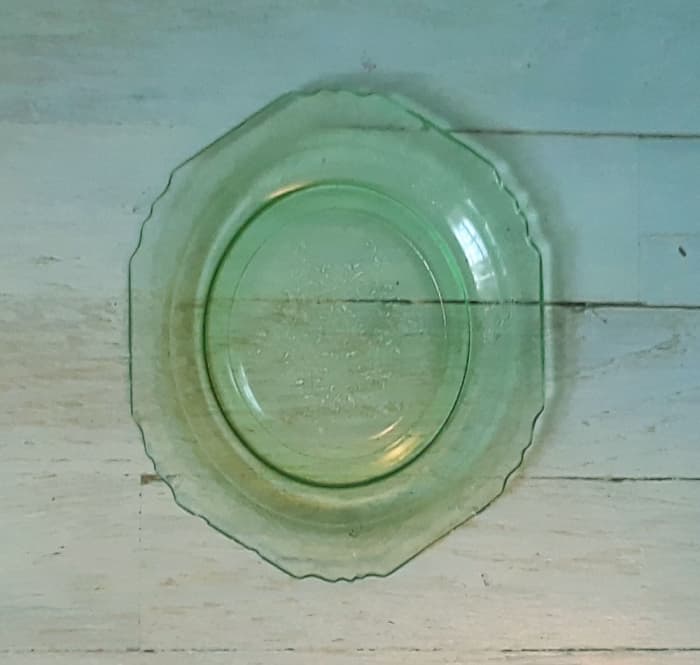
Florentine #i light-green sherbet plate
Photo by Dolores Monet
Blueprint Guides
Have a close look at the design on your piece. Decide on the prominent motif. It could be a style similar Art Deco or geometric. You may see leaves, flowers, loops, petals, fruit, or birds. Concentrate on those obvious motifs in your search.
Patterns can be confusing so y'all need to hone your powers of observation. For example, English language Hobnail and Miss America can look very similar with just a cursory inspection.
Color
When you lot discover a blueprint that appears to match your piece, check to see if the company that produced that blueprint made it in the color that you accept. If you notice that it did non your slice is a reproduction. Or perhaps you misidentified the piece.
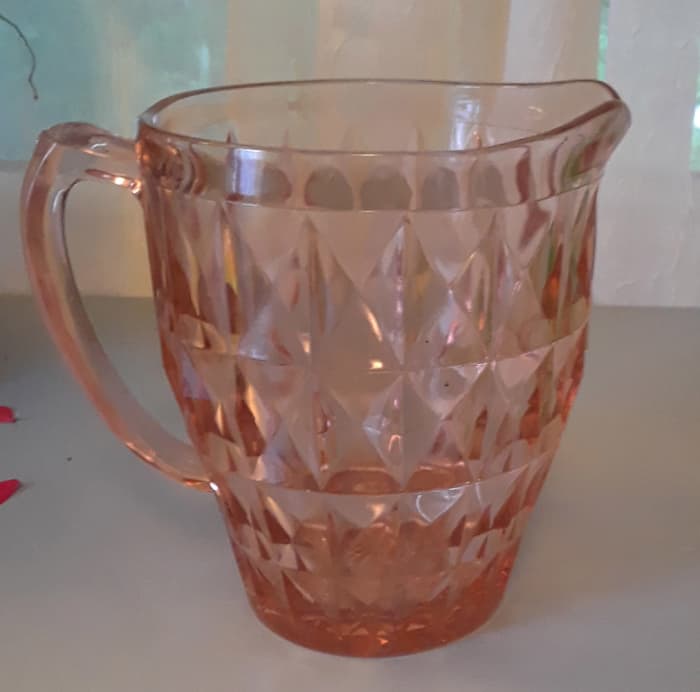
Depression glass Windsor bullpen by Jeanette Glass Company, 1936–1946
Photo by Dolores Monet
The heavy dandy pink pitcher above is a personal favorite for iced tea or ice water. Due to its shape, information technology was like shooting fish in a barrel to identify past pattern. The design is an obvious series of diamonds bisected by vertical lines. The bottom features a circumvolve of elongated diamonds with a heart that resembles a daisy or sunburst.
Looking at various images of diamond patterns, I decided that my blueprint was Windsor past Jeanette Glass Visitor and produced from 1936–1946. The book I was using did not include the 6 ane/2" tall pitcher. So I searched online and plant the same product at Replacements. The pitcher appears on Ebay priced betwixt ten and sixty dollars. When searching for reliable prices, bank check out prices for sold items.
How to Determine Value
Many informative books on Depression glass are older and will non reflect electric current values. However, these older books can offer a lot of information and can be used to identify your pattern. Some excellent books are no longer in print. The expert news is that older books can be establish used online.
To notice a value for your vintage glassware, shop effectually. Visit local antiquarian dealers. Often, the demand for a particular design varies according to the expanse in which you live. Dealers can be quite informative specially if the shop is not very busy at the time of your visit.
Cheque online auction sites. Look at the "sold" price. Yous may want to disregard the highest asking prices as some sellers overvalue their goods. When browsing online look at sellers who specify the blueprint. That means they have some knowledge of their wares.
If you lot desire to sell your glass, practice not expect to collect the full retail value of a piece as stated at sites like Kovel's or Replacements. Remember that a dealer must make overhead and profit. Consignment shops also must collect a pct of the sold price. Some dealers lower the prices on goods that accept non sold in a specific time.
What is value?
A pink Windsor pitcher (like the 1 shown to a higher place) sold for $40 online. I got mine for free! And then if I sold it for $40, that would be a significant turn a profit!
If you tin can't remember what you paid for a slice, you're downsizing and just need to get rid of stuff, price your glass a flake lower than everyone else. Someone gets a bargain and you get rid of stuff.
Many collectors of the past bought their dishware at flea markets, rummage sales, thrift stores, and yard sales. In that case, you may still brand a tidy turn a profit if you choose to sell today.
Have Care of Your Depression Drinking glass
The general dominion of microwave is that if an item was produced before microwaves were in employ, exercise not place those old things in a microwave. That goes for Depression glass.
Do not clean Low drinking glass in a dishwasher. Wash in warm water past paw with a soft fabric.
If you dearest your quondam glassware, use it! What's the sense of hiding it?
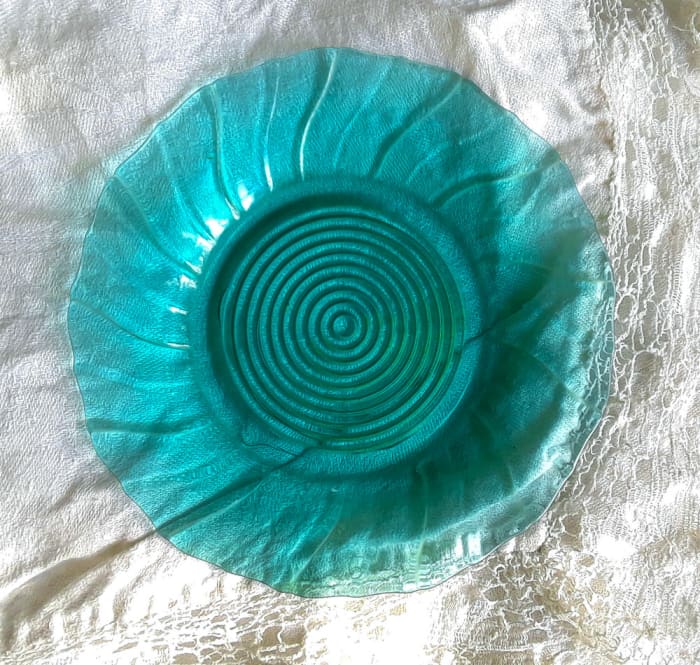
This Swirl or Petal Swirl luncheon plate was piece of cake to identify due to its unusual colour: ultramarine. (Jeanette Drinking glass Company, 1937–1938)
Photo by Dolores Monet
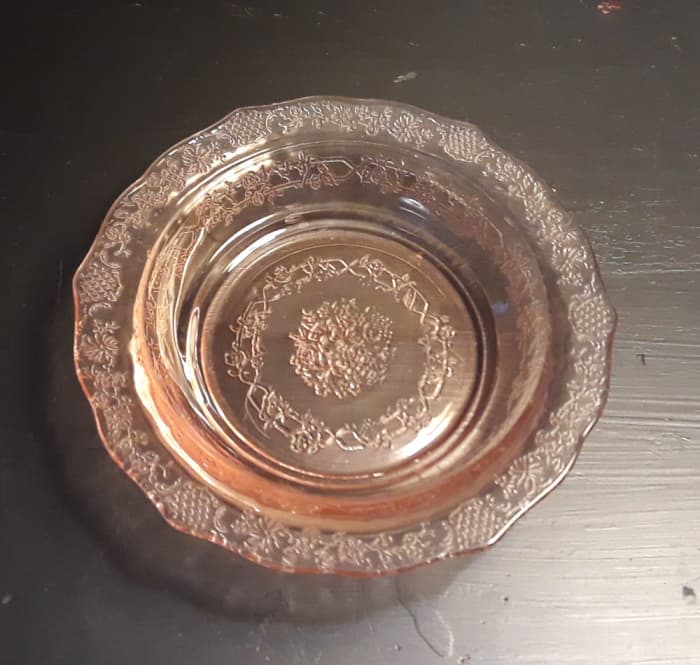
Normandie or Bouquet and Lattice six 1/2" bowl. Look closely at pattern details to assist identify your design.
Photo by Dolores Monet
Further Research
There are tons of books out there nigh Depression glass. An older book may not assist you understand the current value of your items simply tin help you inquiry your pattern. Here are several resources:
- Barbara Mauzy'south Comprehensive Handbook of Depression Glass, by Barbara and Jim Mouzy
- Pocket Guide to Depression Drinking glass and More, by Gene and Cathy Florence
- Colors and Patterns of Depression Era Glassware Revised and Expanded Second Edition, past Doris Yeske and Lyle Fokken
- Warman's Depression Glass Handbook: Identification, Values, Pattern Guide, by Ellen Schroy
- Depression Glass and Across: A Guide to Pattern Identification, Schiffer Book for Collectors
Also check out the National Depression Glass Association where yous can notice information on dealers, conventions, seminars, and shows.
There are many informative online sites that can help you such as:
- Kovel's
- Replacements
- Low, Elegant, and 1940s, 50s, and 60s Glass Patterns, Identification Guide, past Kejaba Treasures
Questions & Answers
Question: Does Depression glass coming in pink have the Lords last supper on information technology?
Answer: Pink drinking glass trays or trinket trays were made to look like Depression glass in the 1970s and 1980s when molded glass was pop. The Last Supper tray also came in aquamarine or teal colored.
Question: I have a very one-time pink measuring cup with no proper noun. In that location are no markings for measuring. What is the value?
Answer: Your measuring cup is most likely ane of a set of four. Liquid measuring cups come with printed or raised lines and measures. Dry out measuring cups fabricated for measuring flour, nuts, and berries do not have markings. The nesting cups came in a one cup measure, a half cup measure out, a third of a loving cup measure out and one quarter cup measure.
Commonly, a piece of a gear up will not be valued every bit loftier as if yous had the unabridged fix. Look effectually online to meet if yous can find the blueprint and asking or sold prices.
Question: I have a pink set depression drinking glass still in its FW Woolworth packaging. It's 4 or 5 boxes of glasses and stemware. Would this be a valuable find?
Answer: The best value in Depression glass depends on if the gear up is a pattern that is in high need. When you lot comparison shop online, expect for items in their original packaging, not simply in Woolworth packaging. I've seen pretty sets offered for up to twenty dollars. Low glass was one time highly collectible just the lack of interest and the vast number of pieces for sale have deflated the value.
Question: Does Low glass come with a mark on the bottom, mine has an F in a shield?
Respond: Some Low glass is marked and some are not. Your F inside a shield indicated that your drinking glass was produced by the Federal Drinking glass Company. Some of their products were not marked. The visitor was founded in 1900 in Columbus, Ohio and produced handmade, etched drinking glass. It went over to mass production in the 1920s. Federal Glass made many popular glass patterns including Normandie, Mayfair, Colonial Fluted, and Raindrops.
Consult one of the books that I accept suggested to find your design.
Question: I'thou trying to find out how much my great grandmother'south antique depression glass is worth. I accept pinkish glass. I have vaseline drinking glass. I take so much! How do I tell what the value is by looking at the marks on the pieces?
Answer: You can identify your Depression Glass by checking out marks on the lesser, simply you besides need to know the pattern. If the mark indicates a particular company, that is a aid, but most companies made several patterns. Yous tin can identify the pattern by using 1 of the many books on the topic. Books show you how to identify patterns by studying shape, edges, color, size, and design. Designs can be floral, geometric, tin can show scrolls, lattice, or other elements. If you await at the products of a particular company, you will discover out that certain patterns made by that company are in higher demand than other patterns made past the same manufacturer.
Once you larn more nearly each slice, y'all can search online to see what each item sells for. When possible, check the sold price. Sellers may over value their wares, and then merely because you see something offered for sale at a high cost does not hateful the seller will actually achieve that price.
Question: Did they always brand pink frosted globes for chandeliers or light fixtures?
Answer: When we think of Depression Glass, nosotros usually think of the popular dishware manufactured during that flow. Many glass companies at that fourth dimension too made jars, lamps bases, and bowls for lighting fixtures. If yous are trying to identify your glass in that location are many resources available including books such as:
"Antique Lamp Heir-apparent's Guide: Identifying Tardily 19th Century and Early 20th Century American Lighting" by Nadja Meril
"Antique Trader Lamps and Lighting Price Guide" by Kyle Husfloen
"Early on 20th Century Lighting Fixtures Featuring Gas and Electric, Ceiling, Wall, Table, and Art Glass Fixtures" past Jo Ann Thomas
"Lighting Fixtures of the Depression Era" past Jo Ann Thomas
Exercise not rely on older toll guides equally they will not reflect current values.
Yous can also check out the Corning Museum of Drinking glass, a site that offers a wealth of information on drinking glass. Detect a drinking glass social club online or in your surface area for more information.
Question: I have a stake pink piece that I believe is a vase for flowers to put at a cemetery stone or mausoleum. I have never seen information technology anywhere. How exercise I place information technology?
Answer: When you search for information nearly a slice, include the size and cloth in your search. Is it metal, glass, porcelain, cloisonne, etc. If information technology appears to be a vase with no base then it is probably a mausoleum piece. If you think information technology is a slice related to the funeral industry, take it to a funeral home and have them accept a look at it. They may be able to signal you in the right management.
Question: I accept a fix of six glasses plus matching bullpen in greenish poinsettia blueprint depression glass. What is the best way to detect a relative value of this gear up of glasses?
Answer: The prepare you lot refer to is often called the poinsettia blueprint because the prototype resembles that popular Christmas plant. Produced between 1931 - 1935, by the Jeanette Drinking glass Company the set was originally chosen Floral. In her famous volume on Depression drinking glass, Hazel Marie Weatherman referred to the pattern as "passiflora."
The pretty pitcher is cone-shaped, tapering down to a footed base of operations. It has a nice, sturdy handle. Glasses are also cone-shaped. The gear up likewise comes in pink.
Follow the suggestions in the article to understand the value. Expect for the set online to check asking or sold prices.
Question: I take a Dunbar Glass Co. pitcher. Information technology stands almost 9 inches tall, bulbous ringed body, footed base and and the clear handle is attached. The color is Cobalt Bluish. Is it worth anything ?
Answer: Y'all can find an image of what may exist a smaller version of your Dunbar cobalt glass pitcher on the Museum of American Glass website. The bullpen there is decorated with hand painted tomatoes and was made in 1947. Cheque out the site to find more data about drinking glass.
Dunbar Drinking glass operated in Dunbar, Due west Virginia from 1913 - 1953 and was Flint Dunbar until the 1930s.
You may as well find information online at the Corning Museum of Glass. Visit some drinking glass shows to acquire more. You'd exist surprised at how many glasses shows there are in many parts of the land. Visiting a show volition help you learn well-nigh current values. You tin can too hunt online sales sites. Cheque with them often as inventories change from week to week.
Question: I accept an aquamarine glass plate with three rings in the middle, similar a teacup saucer. What are the three rings for? Also, no makers marker.
Answer: Of form I tin can't exist sure without really seeing what you mean but it sounds like information technology might exist the lesser of a cheese or butter dish. Round, slightly apartment butter dishes came with a lid. The circles may be where the hat sets. If this is the case, the rings would be slightly raised. Google Depression Glass circular butter dish and see what comes upwards.
Jeanette made Doric and Pansy and Swirl in turquoise or aquamarine. Hazel Atlas used the color chosen Capri in several patterns.
Question: I've inherited my grandparents clear with gold plated accents, cut glass bowl. It is signed on within with a "G and what looks similar an arrow". Can you help me identify it?
Answer: The marker you describe sounds like the mark Imperial Glass Corporation used from 1951 - 1972. It is the letter of the alphabet G over the letter I just information technology looks like an arrow to me. Google epitome the mark to come across if information technology'due south the one y'all mean.
Regal Glass was founded in 1901 as New Crystal Glass just quickly changed to Majestic Glass. It was founded by Edward Muhlemon in Belaire, Ohio. During the early function of the 20th century, they made products for Woolworth's. They produced Carnival glass beginning in 1909. Later, they made imitation cut drinking glass and art drinking glass. They became Imperial Drinking glass Corporation in 1931 creating Elegant glass as well as the famous Candlewick blueprint. The company began to reissue old patterns in the 1960s and went out of business in 1984.
halliganirint1985.blogspot.com
Source: https://hobbylark.com/collecting/How-to-Identify-and-Value-Depression-Glass
0 Response to "Warman's Depression Glass: Identification and Value Guide Read Online"
Post a Comment